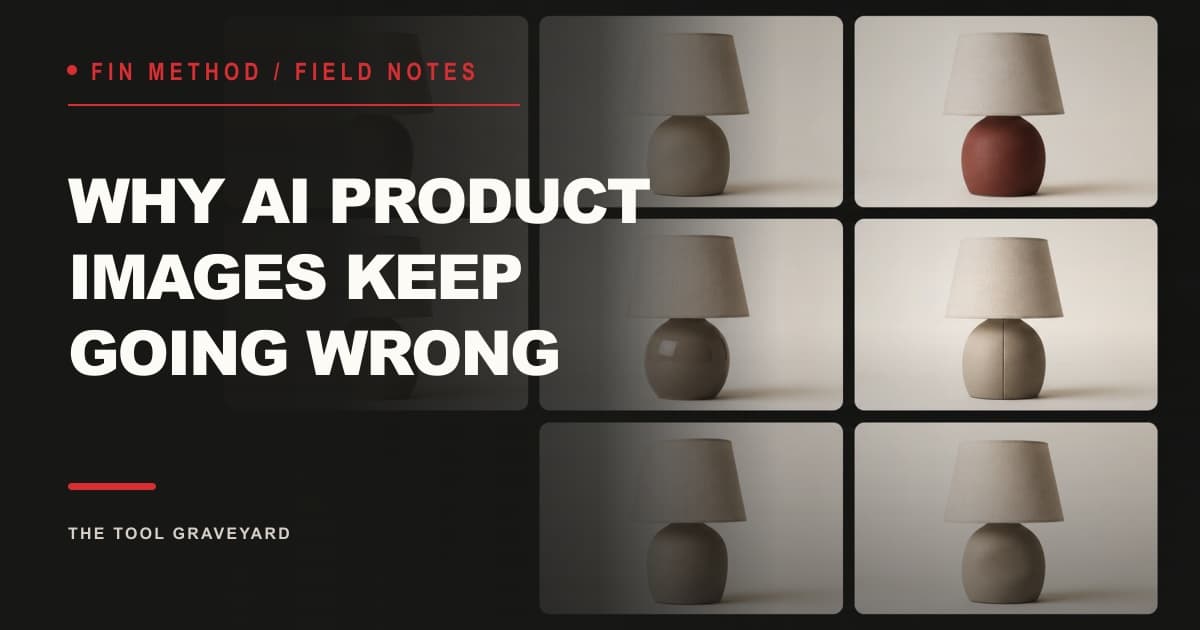
I needed product photos. Not campaign photos, not a hero shot for a billboard. The ordinary, unglamorous kind: a clean image of a product on white, and a few lifestyle scenes that made it look like it belonged somewhere nicer than a warehouse shelf.
The quote from a photographer was around £500 for a half-day shoot. For one product. I had a catalogue.
So, like most operators in 2025, I opened an AI image tool and assumed the problem was already solved. It was not. What followed was one of the more educational weekends of my life, and it's the reason Vision Studio exists.
The tour of everything that got it wrong
I did not try one tool. I tried all of them, methodically, over several days, because I kept assuming the next one would be the answer.
ChatGPT gave me back a product that was recognisably not mine. Same category, roughly the same shape, but the details were invented. If I'd put that on a listing, a customer would have received something different from what they saw, which is a return, a bad review, and on Amazon, eventually a suppression.
Gemini did something similar, with a confident polish that made the wrong details harder to spot at a glance. That's arguably worse. A clumsy mistake you catch. A tidy one you ship.
Midjourney made genuinely beautiful images. It also changed the material. A textured fabric came back looking like moulded plastic. The proportions drifted. It was producing a product, gorgeously lit, that happened not to be my product.
Adobe's AI generator was more restrained, but I was still editing every output in Photoshop afterwards to undo the things it had changed. At which point I had to ask what I was actually paying the AI to do.
Every one of these tools has a real use. None of them was built for the thing I needed: take this exact product and put it in a better scene without touching the product itself.
The 8-hour weekend
Stable Diffusion was where I got stubborn.
I spent an entire Saturday, roughly eight hours, trying to teach it my product properly. I fed it reference images from photography books to explain how light behaves on different surfaces. I pulled from interior design references so it would understand what a believable room actually looks like. I built out prompts with the kind of detail you'd give a junior photographer who'd never seen the item.
At the end of it, I had something decent-ish. A usable image. Progress.
It still needed Photoshop. After eight hours of teaching a model about my own product, I was still opening the result in an editor to fix what it had gotten wrong. That was the moment the actual problem became obvious to me, and it wasn't the one I'd been trying to solve all weekend.
The problem was never the prompt
I'd spent days assuming I was bad at prompting. Better references, better wording, more detail, and surely the output would hold.
But the failure was structural, not a skill issue. Every one of these tools works by redrawing the image from scratch. You give it a product and a description, and it generates a brand-new picture that resembles the input. "Resembles" is the problem. A resemblance is not your product. It's a confident guess at your product, and it guesses wrong in exactly the places that matter: the texture, the logo, the proportions, the specific things a buyer checks before they trust you with their money.
No amount of prompting fixes that, because you can't prompt your way out of a tool whose entire method is to reinvent the thing you asked it to preserve.
For a marketer making a mood board, a resemblance is fine. For an operator putting an image on an Amazon listing, where the picture is a promise about what arrives in the box, a resemblance is a liability. It fails Amazon's accuracy rules, and it drives the returns that quietly eat your margin.
So I built the one that keeps the product
Vision Studio started as the tool I wanted that weekend and couldn't find. The design constraint is the whole point: it locks your product, pixel for pixel, and only changes the world around it. The lighting, the surface, the setting, the scene all move. The product does not.
You upload one photo. You get back the studio shots, the lifestyle scenes, and the full nine-image Amazon listing pack, with the product still exactly as it is. No re-teaching a model over a weekend. No Photoshop pass to undo the hallucinations. No customer receiving something that doesn't match the picture.
It's not a better prompt. It's a different method, built by someone who lost a weekend proving the old method doesn't work.
If you've had the same weekend, you can try Vision Studio free. Five generations, no card. Upload the product that every other tool kept changing, and see it stay put.